It's been another year of odd weather. Again, we nearly drowned early on, with rainfall more than 6" above average from April through June. And then, again, the faucet went off. We're down at least 3" from average for July to now. This is the third year in a row. Will this be our new pattern? Wet and dry seasons, instead of precipitation more evenly distributed? And so much of what we get is in big huge storms, not bits here and there. That kind of rain often just mostly runs off, as it can't soak into the ground fast enough, making our drought situation more drastic than the stats might otherwise indicate. And we sure went from cool to hot! We're at 19 days over 90 for the summer now. The average is 11 (and that's the 30 year average - I wish I knew what it was since record keeping began, as I'm sure 11 reflects our recent warming trends). We've even had more days above 90 than Atlanta! There's something just terribly wrong about that... If the pattern continues, I foresee a huge shift in what people plant. Crops, flowers, trees, lawns - we'd have to all shift to things that can take those extremes. Water will likely become more scarce, and we won't be able to use it for something as frivolous as a lawn (frivolous compared to, oh, drinking or crops). Did you know White Bear Lake leaks out the bottom? Between that and water draws from local communities, the level is terribly low right now. So low they're talking tapping the Mississippi. Well, not everyone can do that, or the mighty Mississippi won't be mighty anymore! That's one reason we went with natives on the boulevard. Once established, they should withstand the extremes better. But again, they've adapted to sporadic rain, not deluge followed by drought, so we'll see.
Veggies/fruits: Great peppers, peas, raspberries and rhubarb. Pretty good carrots - better than we've ever had. Terrible tomatoes - again. They might have been too shaded by the raspberries. I don't know. Never had this kind of trouble. Next year I'm going back to my tried and true Sweet 100s. I've got about 6 immature tomatoes, while others are reporting bumper crops.
 Bugs: Those blasted Japanese beetles came back again, as expected. But this year we were on the lookout for them and got the traps up sooner. I don't think they rose to last year's levels. The traps never got as loaded as they were last year, and there wasn't nearly the damage. Sure, they went after the rhubarb, porcelain berry vine and four o'clocks, but they didn't destroy anything completely.
  Main garden: I have to say the perennials did very well indeed. The annuals? Much more mixed. Still no snapdragons to speak of, for the second year. That makes me sad - they're among my favorites. So are four o'clocks. Not only did the beetles chew on them, I planted them too far back among taller flowers and can barely see them. This year, that's not so bad, as they're terribly chewed... I'll have to remember to treat them next year. I've decided to just plant white impatiens under the blue false indigo. They give quick color all season. I'll still put in the lisianthus, as it lasts a long time and is taller, but I want the impatiens, too.
 The Ruby Grass and Cramer's Amazon Flamingo flowers I planted after seeing them in St. Cloud last year didn't do as advertised. Instead of a pretty grass with pink plumes waving above shown at the top here (the Ruby Grass), I have the grass. Now it's pretty, but I wanted the plumes! The Flamingo flower disappointed, too. No big bushy plants with these lovely flowers (right). Nope, I have very tall spindly plants with tiny little bottlebrushes (left).
 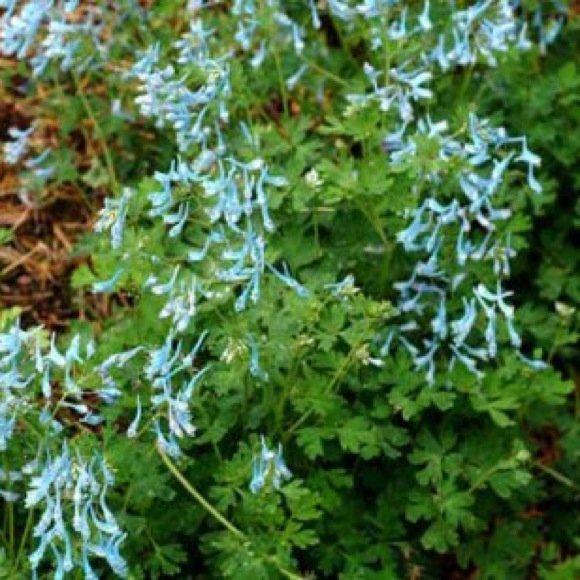 My biggest disappointment? Gotta be Fumeroot - this lovely blue thing. I knew it was a Zone 5 when I got it, and hoped to baby it through the winter. Well, since it didn't ever grow or produce a single flower, that won't be happening. 10 bucks a pop. What a waste. On happier notes, my rose is alive! It has one sprig of leaves. Now whether it's the rose I want or the graft stock remains to be seen, but it's something. And the new clematis I put is is fabulous! Its name is Killian Donahue. It promised to bloom all summer, and, boy, it delivered (still delivering, too). I think the first flower showed up within a week or two on the then tiny plant, and it's never stopped. Now it's so big it overgrew its trellis and has kind of toppled over onto the plant next to it! The flowers are small, only an inch or so across.
They start out yellow and shade into a deep orange as they mature. I was worried about the Russian Sage in June. It's always slow to break dormancy, but this year really lagged, and big pieces didn't seem to come back at all. I chopped a whole bunch out. I needn't have worried - it's as big as ever! What we have noticed, though, is that it isn't buzzing with bees as it usually does this time of year. Whle bees are certainly around, they look to be mostly bumbles. Usually the sage and the Autumn Joy Sedum are just covered in bees (anyone besides Joe and Kendra get that one?), but not so much this year. I've noticed more this week, but believe the absence speaks to the loss of so many bees we've been hearing about. I have to admit I'm still sporadically ticked at the theft of my fuschia. They were the best I'd ever had, and to have them yanked just irritates me beyond belief. What possible purpose could be served by that?
 |
| Main garden, late summer |

to a point - and the asters are looking to take over! I'm going to have to rein them in next year. You can see the butterfly weed and pearly everlasting spreading here. The prairie onion did nothing - no idea why. The Fireweed has been glorious - and it's only the second summer. I have a feeling it'll be another one I need to keep under some control, or all we'll have are asters and it! Some others haven't done so well. I'm about to give up on royal catchfly, which sorely disappoints me, as it's the rare red prairie flower. But in its fourth summer, the 3 or 4 plants I have had one solitary flower. I won't pull it or anything, but doubt it'll last much longer. My obedient plant, which I planted in a ring to keep it from taking over since it's supposed to be really agressive, is all of 6" tall at the end of the season. I think I'm done with it. And my monarda hasn't done so well either, but I think that might be too much shade. I've moved some to a sunnier area and that seems to be doing better. I'm hoping to get coneflowers from a friend when she divides hers - free is good! I have some holes that need filling with stuff that blooms a bit later in the summer, and they fit the bill.
I don't think I ever posted about this. I bought 5 bottle gentian last year. They're supposed to get about a foot high and get purple flowers in the fall. Imagine my surprise when the flowers by those markers were 3 feet high with tiny daisy like flowers in late June! I took samples to Outback Nursery, as they were surprised by this. Turns out the daisy type flowers are some kind of weed (must have come from them...), but I did have a couple of the gentian growing right along with them! Took them home and replanted. Still waiting for them to do something, but it isn't exactly fall yet.
Now we wait and see how long this fall is - they're certainly longer than when I was a kid.


No comments:
Post a Comment